Your AWS account as code. Checked to zero diff.
Orefy turns what was clicked together in the console into readable Terraform that belongs to you.
- Read-only access
- In development
- Available from Q1 2027
Raw infrastructure in. Refined code out.
The first version focuses on one AWS account in one region. Every step shows where it stands today.
| Resource | Type | Managed by |
|---|---|---|
| prod-main | VPC | ClickOps |
| web-01 | EC2 Instance | ClickOps |
| app-runtime | IAM Role | ClickOps |
| ci-deploy | IAM Role | Terraform |
- versions.tf
- providers.tf
- variables.tf
- network.tf
- compute.tf
- storage.tf
- iam.tf
- messaging.tf
- imports.tf
The check is planned. This is what findings will look like.
Discover what runs in your account
A read-only inventory of your resources, including whether they are managed as code.
| Resource | Type | Managed by |
|---|---|---|
| prod-main | VPC | ClickOps |
| web-01 | EC2 Instance | ClickOps |
| app-runtime | IAM Role | ClickOps |
| ci-deploy | IAM Role | Terraform |
Turn it into readable Terraform
Community modules with pinned versions where they fit, plain resources where they do not, and import blocks for what exists.
- versions.tf
- providers.tf
- variables.tf
- network.tf
- compute.tf
- storage.tf
- iam.tf
- messaging.tf
- imports.tf
Check that nothing would change
The code is planned against the live environment. A run only succeeds when the diff is zero.
Find security and compliance gaps
Findings mapped to the frameworks you report on, each with a fix as a code change.
The check is planned. This is what findings will look like.
See it for yourself. In three minutes.
Take an example AWS account from ClickOps to Terraform. No sign-up, no cloud access, nothing to install.
- 01
See what runs
37 example resources, 34 of them created by hand.
- 02
Get code and a check
Readable Terraform, compared until the plan shows no change.
- 03
Hand it to your teamPlanned
GitHub or GitLab, a pipeline and an approval before apply.
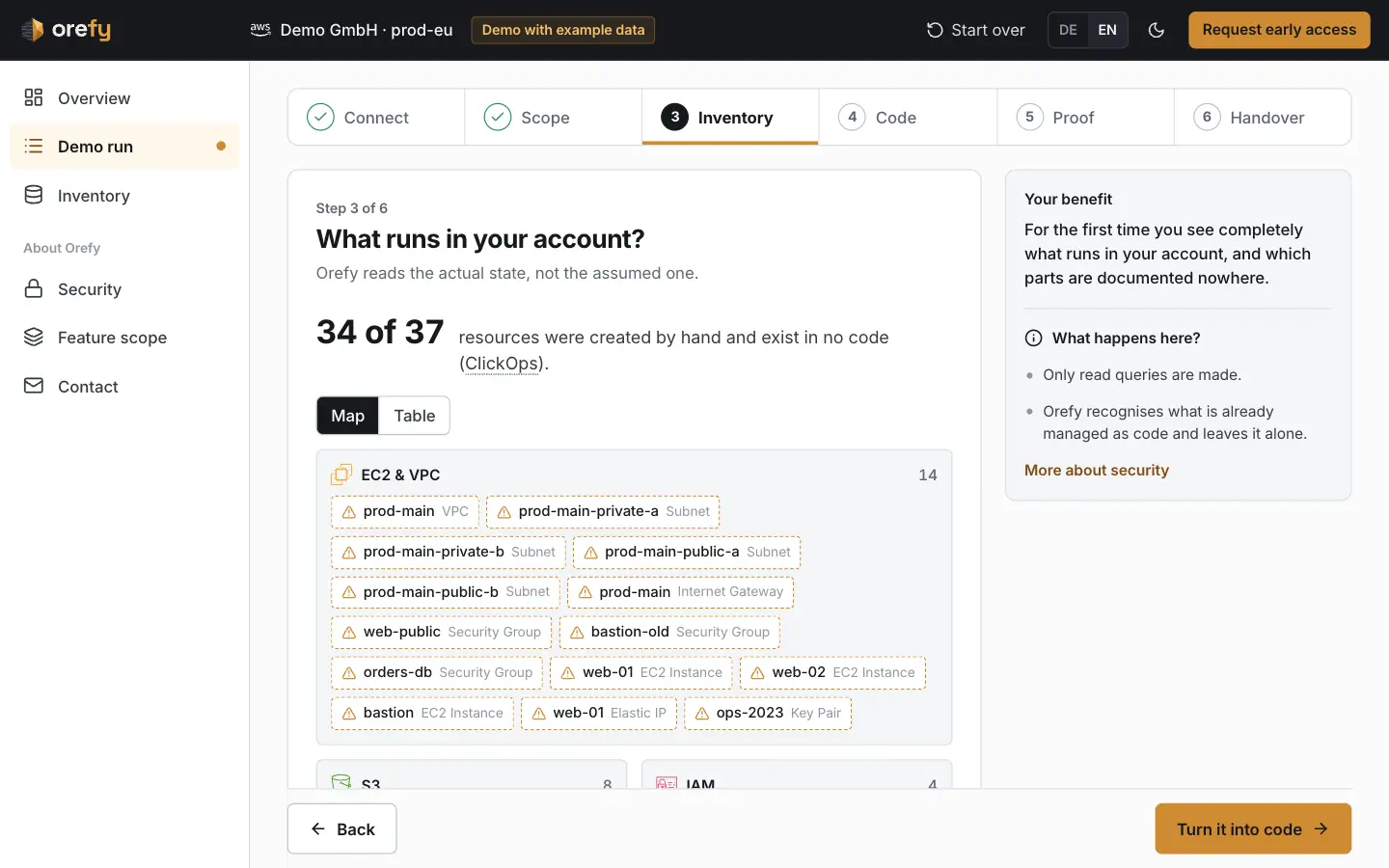
Everything is simulated with example data. Features that are not built yet are marked as planned.
Your environment stays yours.
Access to your infrastructure takes trust. These limits are the foundation of Orefy.
Read, never write
The tooling only allows read calls. That limit is in the code, not in an instruction to an AI.
Secrets stay out
Calls that return secret values are blocked. What still looks like a secret is redacted before it reaches a model, file or log.
A person applies
Orefy does not apply code. Your team reviews it and decides when it takes effect.
No lock-in
The result is ordinary Terraform in your hands. It keeps working without Orefy.
Built in Germany, by VAMIT.
Orefy is a product of VAMIT UG (haftungsbeschränkt) in Bocholt. You write directly to the team that builds it.
About VAMIT ↗Become a pilot team
You have an AWS environment that grew by hand? Help decide what Orefy supports first.
Talk to usWhat teams ask first.
Can I use Orefy today?
Not yet. Orefy is in development and planned to be available from Q1 2027. You can try the simulated demo now and ask for early access.
What does the first version cover?
AWS and Terraform, starting with one account and one region. Multiple accounts and regions, OpenTofu and compliance checks are planned.
Can Orefy change or break my environment?
Orefy is designed for read-only access: the tooling only allows read calls and cannot run an apply. Changes happen when your team applies the code.
What happens if a resource cannot be turned into code?
It is shown in the result. Where no module fits, the resource is described directly and marked. What cannot be expressed stays unmanaged.
Does Orefy make us NIS2 or ISO 27001 compliant?
No tool can do that alone. Infrastructure as code makes changes traceable. Checks against these frameworks are planned and do not replace an audit.
Refine the raw.
Be among the first teams to bring their cloud under control.